



The stage most likely to create repeated revisions in a custom faucet project is often not mass production, but the period before the first sample is made.
The reason is simple:
The product has not yet been clearly defined, but sampling has already started.
For a Multi Function Kitchen Faucet, this problem can be even more obvious because function, structure, installation and accessories are closely connected. A seemingly small change can affect other areas that have already been confirmed.
Turn “What We Want” Into Product Specifications Before Sampling
Take a spring hose kitchen faucet as an example.
Confirming the appearance alone is not enough.
The spring structure, spray head, hose, water modes, overall body height and operating method all contribute to the final product.
If some of these elements remain undecided, changing the spray head or function after the first sample is completed may also require related dimensions and configurations to be reviewed again.
Before sampling begins, several basic points should therefore be confirmed:
- required functions;
- installation method and connection specifications;
- approximate dimensional relationship between the body, handle and outlet;
- material and finish;
- accessories included with the complete product;
- any special requirements for logo and packaging.
Together, these elements form the basic product version.
The purpose is not to lock every detail permanently before the first sample. It is to make sure that the first sample has a clear product definition to verify.
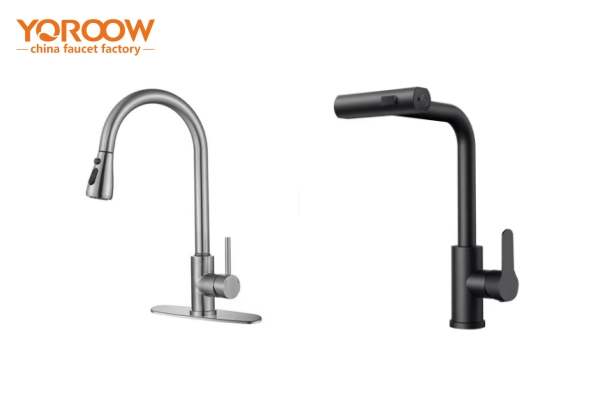
The More Functions a Product Has, the More Important It Is to Define the Boundaries
A standard hot and cold kitchen faucet has a relatively straightforward functional relationship.
Once pull-out operation, multiple spray modes or electronic controls are added, however, the product definition cannot stop at the term “multifunctional.”
For example, with a touch-infrared kitchen faucet, it is necessary to define exactly what the electronic function controls and how it interacts with manual operation.
If these questions are not clear, the sample stage is forced to perform two jobs at the same time:
defining the product and validating the product.
The result is that each sample changes the development target instead of checking the same target.
The Manufacturer Needs an Executable Product Definition
Once a design concept moves into the sample stage, requirements such as functions, dimensions, finish and accessories need to be translated into specifications that can actually be manufactured.
Using YOROOW as an example of a China faucet factory providing OEM/ODM services, confirmed requirements for function, finish, configuration, logo and packaging need to be carried through into a specific product and sample version.
The value of this step is not to create more process.
It is to make sure everyone is reviewing the same version of the product.
When the spray head, dimensions, function or finish changes, it also becomes easier to determine whether that change affects other confirmed configurations.
Samples Should Validate the Product, Not Continuously Redefine It
Samples can and should be adjusted, but those adjustments should be based on an already confirmed baseline version.
A practical approach is to prepare a product specification list before the first sample and identify the current version clearly.
If the spray head, dimensions, function or finish changes later, record the change and check whether it affects any other configuration.
The purpose is not to add paperwork. It is to prevent different participants from working from different interpretations of the same product.
Product definition should also go beyond reference images.
For a hot and cold kitchen faucet, formal confirmation should make sure that dimensions, materials, installation requirements and relevant performance information all correspond to the same specific model.
For products intended for particular markets, applicable standards and testing requirements should also be confirmed according to the target market.
ASME A112.18.1/CSA B125.1 is one standard that applies to plumbing supply fittings. Its scope includes kitchen, sink and lavatory supply fittings and covers relevant design, performance and testing requirements.
However, it does not represent every requirement in every market, so one standard should not be used as a substitute for market-specific compliance confirmation.
A custom project is truly ready for sampling not when the appearance drawing is finished, but when the product’s function, structure, configuration and customization boundaries are clear enough for the sample to perform its real purpose:
validation.