



A kitchen faucet may retract smoothly on a showroom display but struggle to return once installed in a customer’s cabinet.
Above the countertop, pull-out and pull-down faucets may look like two design choices. Below it, however, the hose may need to move around a drain pipe, water filter, storage basket, supply connections, and other equipment.
For retailers comparing pull-out vs pull-down faucets, sink geometry and cabinet layout should be part of the evaluation. Product photos alone cannot show whether a faucet will work well in a specific installation.
Pull-out and pull-down generally describe the direction in which the spray head moves away from the spout and the overall faucet configuration. They are not two fixed performance levels.
The useful comparison starts with the actual product: its outlet position, operating path, hose movement, and retraction system. These details can then be matched to the intended sink and cabinet environment.
Start by Turning the Product Name Into an Actual Movement
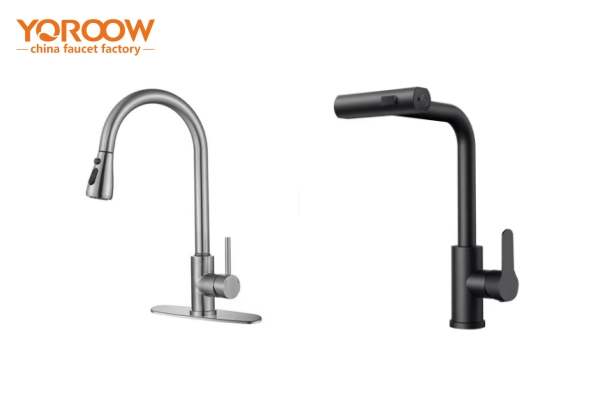
A pull-out spray head typically extends outward in the direction of the spout. A pull-down spray head usually moves downward from the end of a higher-arc spout.
However, actual faucet height, spray-head angle, reach, and retraction design still vary by model. Delta also presents pull-out and pull-down configurations as different options in kitchen faucet selection.[1] The category name alone does not determine the usable reach of a specific faucet.
The way someone works at the sink is a better starting point.
Does the spray head frequently need to reach a far corner of the sink? Is most cleaning done directly below the fixed outlet? Does the user regularly handle tall cookware? Does the spray head need to move between two bowls?
These actions affect how spout height, horizontal reach, outlet position, and spray-head handling should be evaluated.
Retailers can define these target scenarios before requesting candidate models from a supplier. Broad statements such as “pull-down faucets are always better for large sinks” or “pull-out faucets splash less” should not replace product testing.
Sink geometry, water landing point, flow conditions, and user movement all affect the result.
Check the Space Above and Below the Countertop
The first installation drawing should describe the space above the countertop.
Useful dimensions include the distance between the mounting hole and sink edge, outlet height and horizontal position, overall faucet height, and the full handle movement. Nearby walls, windows, and other obstacles should also be shown.
Overall faucet height alone does not tell a buyer whether tall cookware can fit comfortably under the spout. It also does not show where the water will land inside the sink.
The second drawing should describe the space below the countertop.
This includes countertop thickness, access for mounting hardware, supply connections, the drain system, and other equipment inside the cabinet.
For models that use a counterweight or similar hose-retraction arrangement, the hose and related components also need enough unobstructed space to move. Moen installation information for relevant models includes clearance requirements for hose and weight movement.[2] These model-specific instructions illustrate what buyers should check; their dimensions should not be treated as universal requirements for all pull-out or pull-down faucets.
Both drawings should use clear measurement references.
If a product page lists “spout reach,” buyers need to know where that measurement begins. It may be measured from the faucet centerline, base, or another defined point.
Likewise, total hose length is not the same as usable pull-out reach. Part of the hose remains inside the faucet and below the countertop. Actual usable movement should be confirmed with the faucet fully assembled.
Compare the Faucets in Three Installation Scenarios
The following scenarios are a practical way to evaluate samples. They are not standardized test results or proof that a product has passed a specific performance requirement.
The sink and cabinet should represent realistic conditions for the intended sales channel. Sample configuration, installation method, and water conditions should also be recorded.
| Scenario | What to Observe | Decision Output |
|---|---|---|
| Everyday sink operation | Water landing point, spray-head handling, mode switching, and usable reach | Identify which tasks are comfortable and where movement becomes restricted |
| Limited-clearance installation | Interference with handles, walls, windows, mounting hardware, and under-sink equipment | Define confirmed installation conditions and limitations |
| Repeated pull-out and return | Hose path, obstruction, spray-head docking, and connection condition | Separate installation-layout issues from product issues requiring further investigation |
For everyday operation, the same cookware and sink conditions should be used when comparing two candidate faucets.
If one faucet is tested in a deeper sink or at a different flow rate, a difference in splashing or usability may come from the changed conditions rather than the faucet itself.
The clearance check should stay within the installation conditions allowed for the product. For example, if a handle is close to a wall, check its complete operating path rather than only its closed position.
Countertop thickness also needs to be evaluated against the actual mounting structure, not simply by checking whether some thread remains visible.
The repeated pull-out and return check has another limitation. A few sample operations can reveal obvious inconvenience or interference, but they do not replace durability testing or demonstrate long-term reliability.
If the spray head does not return smoothly, first record the hose path, possible obstacles, retraction-component position, and docking condition. That information helps determine what should be investigated next.
Evaluate Retraction and Docking as Part of the Complete Faucet
Hose retraction and spray-head docking are related, but they are not exactly the same function.
Some designs use gravity and a counterweight to help retract the hose. Others may use a separate feature to hold the spray head in its final docking position.
Buyers should therefore ask how the specific model works instead of treating one marketing term as a complete description of the mechanism.
Moen’s hose information also shows that connection arrangements can differ between pull-out and pull-down faucet models.[3] This leads to an important purchasing consideration: replacement hoses and connectors should be identified by the actual faucet model rather than ordered simply as a generic “kitchen pull-out hose.”
Other manufacturers and models may use different connections, so their documentation should be checked separately.
If a faucet does not retract correctly, the cause should also be separated before deciding on a solution.
An obstructed hose path may require an installation adjustment within the product’s permitted conditions. Incorrect assembly should be corrected according to the model instructions. Damaged parts or abnormal component fit may require supplier evaluation.
Adding extra weight or repeatedly pulling the hose should not be treated as a universal fix.
Maintenance access is also worth checking during sample evaluation. If the spray head or hose needs replacement later, the cabinet should provide reasonable access to the relevant connections.
More Spray Modes Do Not Automatically Mean Better Market Fit
The number of spray functions should not become the main criterion in a pull-out vs pull-down keukenkraan comparison.
What matters is whether the functions are clear, practical, and suitable for the intended sink tasks.
Flow conditions should also remain consistent when comparing samples. Spray pattern, water landing point, and perceived splashing can change with both the faucet configuration and the test conditions.
If a product page publishes flow information, the corresponding configuration and test conditions should be clear. Claims about stronger flow, wider coverage, or other user experiences should also have an appropriate basis.
Turn Sample Findings Into Six Useful Pieces of Product Information
A pull-out vs pull-down comparison has limited value if the product page only describes appearance and feature count.
Sample evaluation can instead produce information that helps buyers understand installation compatibility before purchase:
- Key faucet and installation dimensions, with clear measurement points.
- Outlet position and usable spray-head reach, without confusing usable reach with total hose length.
- Space required for full handle movement and any confirmed installation limitations.
- Under-sink requirements for hose movement and the retraction system.
- Included accessories and any items that must be prepared during installation.
- Operating, maintenance, and replacement-part information relevant to the specific model.
Some information can be expressed as exact dimensions. Other points may be better shown through an installation drawing or a conditional note.
When the information has not been confirmed, terms such as “universal” or “suitable for any sink” should not be used to hide the gap.
Clearer product information also helps customer service teams distinguish an installation-compatibility problem from a product problem.
Installation information on packaging, online dimension drawings, and printed instructions should remain consistent. If a hose connection, handle movement, or other relevant product detail changes, the affected channel information should be reviewed as well.
Three Questions That Often Come Up During Product Selection
Does a small sink mean the retailer should only choose a pull-out faucet?
Not necessarily.
The decision should be based on the actual outlet position, spray-head movement, sink geometry, and surrounding installation limits.
The relationship between the faucet and the sink explains compatibility better than the category name alone.
Does a longer hose always give the customer more usable reach?
No.
Part of the hose is used inside the faucet and below the countertop. Connections, hose routing, cabinet clearance, and the product’s intended operating range also affect how far the spray head can actually move.
Usable reach should therefore be checked with the complete faucet installed.
If the spray head retracts smoothly on the showroom display, is that enough to approve the product?
A showroom display only demonstrates performance under that particular installation.
The faucet should also be evaluated in an environment that represents the intended sink and cabinet conditions. A showroom does not reproduce every drain pipe, filter system, storage arrangement, or clearance limitation found inside a customer’s cabinet.
Choose the Faucet for the Installation, Not Just the Category
Choosing pull-down faucets for a market—or deciding between pull-out and pull-down models—requires more than identifying a preferred style.
Sink dimensions, countertop conditions, cabinet layout, hose movement, and the user’s main sink tasks can all affect the final choice.
For projects with defined installation conditions, this information can also help YOROOW narrow down candidate models and prepare more relevant samples for evaluation.
The useful conclusion is not simply that one faucet is “pull-out” and another is “pull-down.” It is understanding where a specific model can operate as intended, what installation conditions it requires, and what evidence supports that decision.
References
[1] Delta Kitchen Faucet Buying Guide。
[2] Moen INS1914F安装资料。