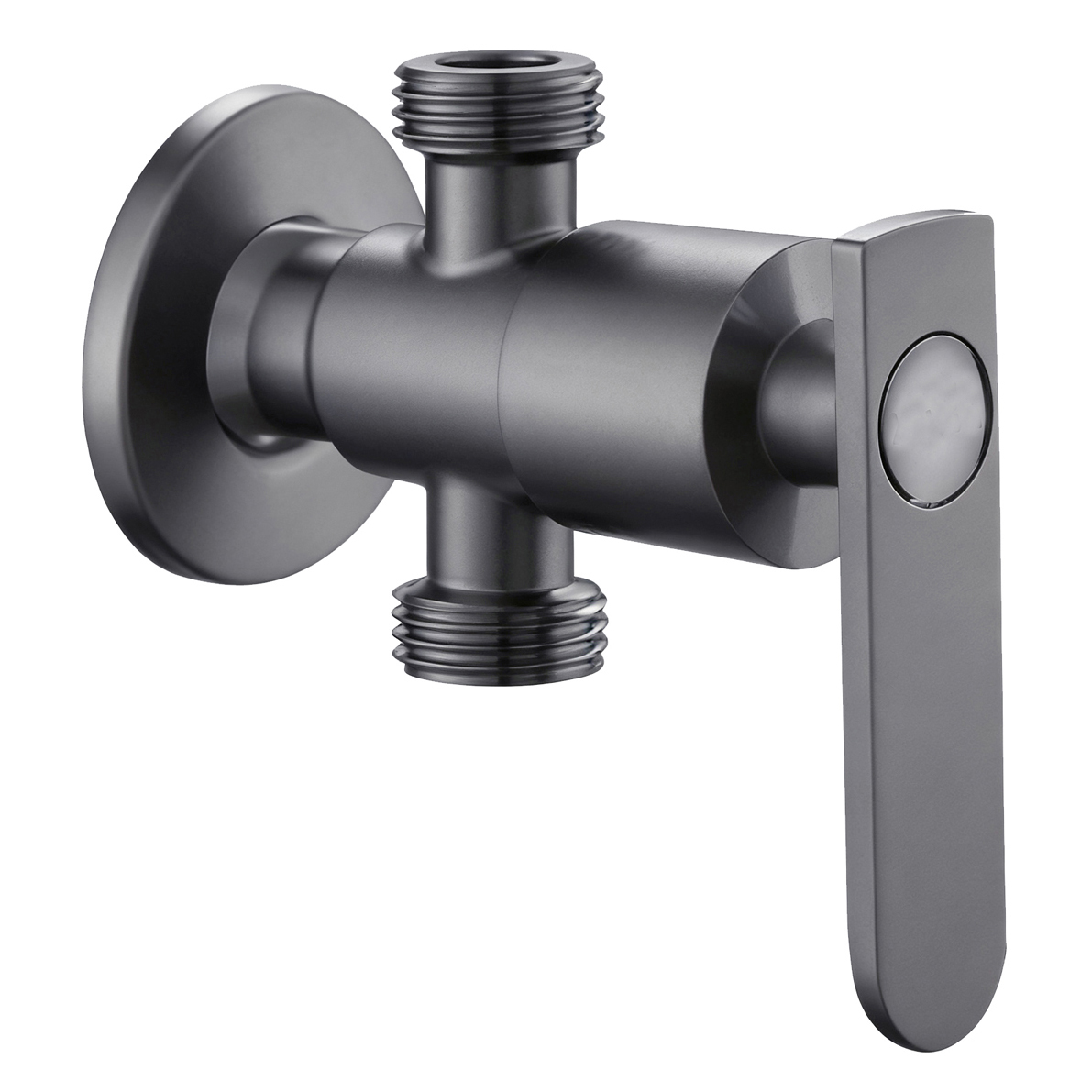




As order volume increases, the same faucet model may show differences in operating feel and assembly condition.
These differences do not necessarily come from a single component. Small variations in installation position, component orientation, tightening, seal placement, and assembly sequence can all affect the final product.
For a Double Handle Shower Faucet, these differences are especially easy to notice because both control points appear on the same product and can be compared directly.
Double Handle Shower Faucets Are More Sensitive to Assembly Consistency
Take a Double Handle Shower Faucet as an example. Both handles need to maintain relatively consistent installation positions and operating conditions.
If one side feels noticeably tighter while the other feels looser, or if the two handles stop at different positions when closed, the basic function may not be immediately affected. However, the overall assembly consistency of the product will appear unstable.
For a dual handle bath shower faucet, it is also important to check whether the control components, connectors, and seals follow the same assembly requirements.
This is one practical difference between a double-handle structure and a single-handle faucet. Any difference between the left and right sides appears directly on the same finished product. A variation may not be obvious when one control point is viewed alone, but differences in position and operating condition become easier to notice when both handles are compared side by side.
Assembly Consistency for a double-handle faucet should therefore go beyond confirming that both controls work. Their relative condition within the same product also needs to be checked.
Small Variations Are More Likely to Appear in High-Volume Production
A small sample batch may be assembled by the same workers, making it easier to keep the process consistent.
Once production moves to larger volumes, differences can appear between workstations and operators if there are no stable requirements for installation position, tightening, seal placement, or assembly sequence.
Individually, these variations may seem minor. Across the same order, however, they can appear as:
Different final handle positions;
Differences in left and right operating conditions;
Inconsistent component orientation;
Different assembly conditions at connection points;
Abnormal seal placement.
For this reason, Assembly Control in high-volume production cannot rely only on final product sampling.
Key assembly steps need to remain consistent throughout production. These include component orientation, installation position, assembly sequence, and the sealing points that require confirmation.
For products with two corresponding control points, both sides should also be inspected as one complete product rather than checking only whether each individual component has been installed.
The Approved Sample Should Remain the Assembly Reference for Mass Production
What happens after sample approval is directly relevant to assembly consistency.
Once a Double Handle Shower Faucet moves from sample approval into mass production, changes in seal thickness, cartridge batches, thread machining, connectors, or assembly conditions may affect the final assembly state.
An approved sample should therefore serve as more than an appearance reference.
The BOM, key component specifications, installation orientation, and finished assembly condition related to Assembly Consistency should also become references for subsequent production.
First-article confirmation can check whether these conditions still match the approved product. In-process inspection can then identify whether deviations begin to appear during mass production.
If substitute components are required during production, their dimensions, fit, and relevant performance should be confirmed against the original product requirements before mass assembly begins.
Otherwise, a change in one component may affect handle position, connection fit, or sealing condition at the same time.
For a double handle brass shower faucet, this change also needs to be evaluated across both control points. It is not enough to confirm that the substitute component can be installed on its own.
Operating Feel Should Be Evaluated Together with Components and Assembly Conditions
When two handles have different operating feels, the cause cannot be determined from the final feel alone.
The difference may come from the control component itself, but it may also result from installation position, component fit, or other assembly conditions.
If there is a noticeable difference between the left and right handles, or between finished products from the same batch, the corresponding components and assembly steps should be checked.
This matters in high-volume production.
If final inspection only confirms that a handle can open and close, some assembly differences that do not yet affect basic function may continue into later production.
The inconsistency may become much more obvious when several finished units of the same model are compared together.
A stable Assembly Standard provides a clearer reference for operating condition. It also makes it easier to trace an abnormal result back to a specific component or assembly process.
Sealing Inspection Should Match the Actual Assembly Positions
Assembly consistency for a Double Handle Shower Faucet also includes connection and sealing conditions.
Correct seal placement and consistent assembly at connection points directly affect final inspection results.
During mass production, if workers rely on individual experience to complete the same sealing or connection point, differences are more likely to appear across the batch.
Post-assembly inspection should therefore cover the actual connection and sealing positions.
When an abnormal result appears, the inspection should also determine whether the cause comes from the component itself, the assembly condition, or the connection point.
This allows problems found during water testing or other final inspections to be traced back to the relevant production process instead of simply removing defective units from the batch.
Consistent Assembly Creates Stable High-Volume Production
For a double handle brass shower faucet, qualified components are only the foundation of mass production. The final product delivered to the customer is the complete assembled faucet.
Products within the same batch should maintain reasonable consistency in handle position, left and right operating conditions, component fit, and sealing condition.
A Double Handle Shower Faucet also provides a direct way to evaluate assembly consistency: both control points are located on the same product, making differences between the left and right sides easy to compare.
As order volume increases, stable assembly standards, first-article confirmation, in-process inspection, and necessary change control can reduce the accumulation of small variations during mass production.
This helps finished products of the same model maintain a more consistent assembly condition.