



Reducing a time-delay faucet from 12 seconds to 6 seconds may lower the amount of water used in one activation. But if a user has to press the button three times to complete the same washing task, total water use can actually increase.
For buyers, this means that a faster shut-off is not enough to demonstrate either better water efficiency or a better user experience. Flow rate, run time, and repeat activations need to be considered together.
When discussing a configuration with a time delay faucet manufacturer, start with the task the faucet needs to support. Is it intended for public handwashing, quick rinsing, or another application? The operating mechanism and applicable requirements can then be evaluated around that task.
This article focuses on faucets that continue running for a defined period after activation and then close automatically. Terms such as self-closing, push-buttonet metering do not always describe exactly the same operating behavior, so the action itself should be clearly defined when requesting a quotation.
One Activation Is Not the Same as One Complete Use
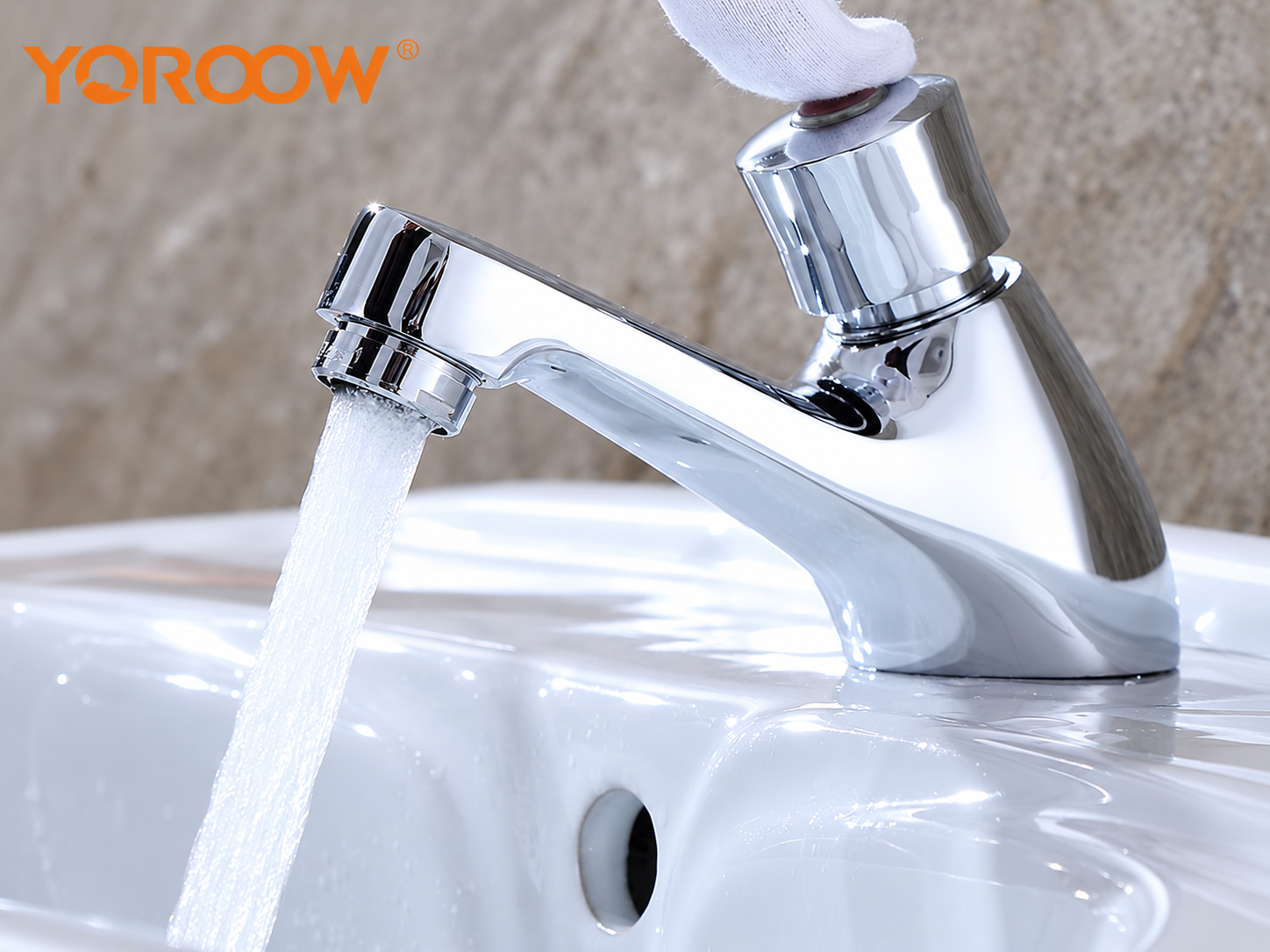
EPA’s WaterSense at Work describes metering faucets that run for a preset time. It also covers self-closing faucets that stop when the user releases the button or removes their hands.[1]
For procurement, the key point is not the terminology. It is how the faucet actually works.
Does the water keep running after the user releases the button? Can the user stop the flow before the preset time ends? If the user presses the button again, does the faucet start a new cycle, extend the current cycle, or work in another way?
When searching for a metering faucet manufacturer, describe the expected sequence as clearly as possible. For example:
Press and release the button, allow the water to run for the preset time, and then shut off automatically.
This gives a clearer specification than simply asking for an “automatic shut-off faucet.”
It also helps to separate two measurements: one activation cycle et one complete user task.
One activation cycle shows how the faucet operates. A complete user task shows how much water the user may actually need.
For example, suppose a faucet runs for 6 seconds each time. If a user activates it three times to finish washing, the total water use comes from three cycles. Counting only one 6-second cycle as the water use “per person” would give a misleading result.
Calculate Water per Cycle—Then Count Repeat Activations
If the flow rate remains reasonably stable during the cycle, water use per activation can first be estimated as:
Water per activation (L) = Flow rate (L/min) × Run time (sec) ÷ 60
If the flow changes significantly during the cycle, measuring the actual discharged volume is more appropriate than applying a single instantaneous flow rate to the whole period.
Consider a simple example. The following figures are hypothetical and are used only to explain the calculation. They are not YOROOW test results and are not pass/fail requirements for any market.
Assume both configurations deliver 3 L/min:
| Configuration | Activations per Complete Use | Estimated Water Use |
|---|---|---|
| 12-second cycle | 1 × 12 sec | 0.6 L |
| 6-second cycle | 1 × 6 sec | 0.3 L |
| 6-second cycle with repeat activation | 3 × 6 sec | 0.9 L |
The example does not show that a longer cycle is always better.
If six seconds is enough for the intended task, the shorter setting may reduce water use. If users repeatedly reactivate the faucet, however, the result changes. This is why the user’s behavior needs to be observed rather than assumed in advance.
Measurement boundaries also need to be consistent. For example, the test method should define how water discharged immediately after shut-off is treated and how normal residual water is distinguished from continued leakage.
Otherwise, two suppliers can test similar products and report different figures simply because they used different measurement boundaries.
Watch Whether Users Can Actually Finish the Task
A water-saving comparison should not ask users to leave a washing task unfinished just to achieve a lower water-use figure.
During a project trial, users can operate the faucet as they normally would. The team can then observe repeated button presses, waiting time, splashing, and confusion about how the control works.
First-time use can reveal problems that a simple water-use test may miss.
For example, a user may not realize that they need to press the button. Another user may keep holding it because they think they must maintain pressure to keep the water running. These reactions may point to unclear instructions or a control design that users do not immediately understand. They are not necessarily a problem with water run time alone.
When evaluating samples with a push button tap manufacturer, the project team can also check whether different users can operate the control comfortably in the intended installation position.
If the project has specific accessibility or operating-force requirements, the team should assess them against the applicable requirements and use the appropriate verification methods. A buyer’s impression that a button feels “easy to press” does not replace objective evidence.
A small internal trial can still reveal obvious usability problems. However, the team should understand its limits. A few employees cannot represent every user group. Larger projects, or installations serving specific populations, may need more targeted evaluation.
Test Run Time and Water Volume Under Defined Conditions
Run time and actual water delivery should be evaluated under defined operating conditions.
The buyer should provide known information about the project’s water supply, while the appropriate technical personnel determine the conditions that need to be covered. If meaningful supply variation is expected on site, the relevant conditions can be evaluated separately rather than testing only one convenient condition.
A useful record can connect:
model and configuration → adjustment setting → supply condition → run time → actual water volume
If the outlet component is changed or the timing is adjusted, the result represents a different configuration and should be identified accordingly.
This is more useful than recording only that a faucet runs for “about six seconds.” Without the associated conditions, the number can be difficult to compare across samples or reproduce later.
For hot-water or mixed-water applications, the buyer should also confirm that the candidate product is intended for that supply arrangement and how temperature control is handled. A time-delay mechanism originally intended for a cold-water configuration should not be assumed suitable for another water-supply arrangement simply because the button operates in the same way.
An Adjustable Timer Still Needs an Approved Setting
“Adjustable run time” gives a project more flexibility, but it also raises another question: who is supposed to make the adjustment?
Buyers should understand the available adjustment range, the adjustment method, any required tools, and how the result is checked afterward. In a public installation, ordinary users may need to be prevented from changing the setting, while authorized maintenance personnel still need reasonable access when adjustment is required.
If different areas of a project use different settings, those settings should remain identifiable. After maintenance or replacement of an applicable component, the team should also be able to determine whether the intended setting has been restored.
Once a configuration has been approved for bulk procurement of wholesale time delay taps, the agreed setting and the conditions under which it was evaluated should remain connected to the order.
If later checks show a difference, the investigation should first distinguish among an adjustment difference, a change in measurement conditions, and an actual product abnormality. Simply calling every difference “incorrect timing” can hide the real cause.
Water-efficiency requirements also need to remain market-specific. China’s Regulations on Water Conservation, effective May 1, 2024, include requirements concerning the use of water-saving appliances in new, renovated, and expanded public buildings.[2] This provides policy context for water-efficient products, but it does not establish one universal run time for every time-delay faucet.
Projects in other markets should confirm their own applicable product and water-efficiency requirements rather than transferring one country’s rules directly to another.
When discussing a time-delay faucet project with YOROOW, specifying only “6 seconds” or “12 seconds” leaves an important part of the requirement unanswered. It is more useful to explain what task one complete use needs to accomplish and the relevant water-supply conditions, and then evaluate the sample by recording both run time and actual water volume.
The useful question is therefore not simply “Which faucet shuts off sooner?”
It is:
“How many times does the user need to activate it to complete the task, and how much water is used by the time that task is finished?”
References
[1] EPA WaterSense at Work 3.3 Faucets。
[2] 中国政府网 节约用水条例。