



The role of kitchen faucets is changing. Beyond basic hot and cold water supply, manufacturers are exploring new spout designs, control methods, and functional features. These innovations aim to improve everyday tasks such as washing food, cleaning dishes, and accessing drinking water.
On November 20, 2026, Spanish kitchen and bathroom industry publication IM Cocinas y Baños published an article titled La grifería amplía su papel en la cocina. It introduced product innovations from several brands in functional integration, water-saving technology, smart controls, and integrated sink design.
These examples show that developments in the kitchen faucet industry extend beyond technological improvements. They also reflect changing kitchen habits, space layouts, and diverse market demands.
1. How Are Kitchen Faucet Functions Evolving?
Flexible Spout Designs Are Expanding Across Product Ranges
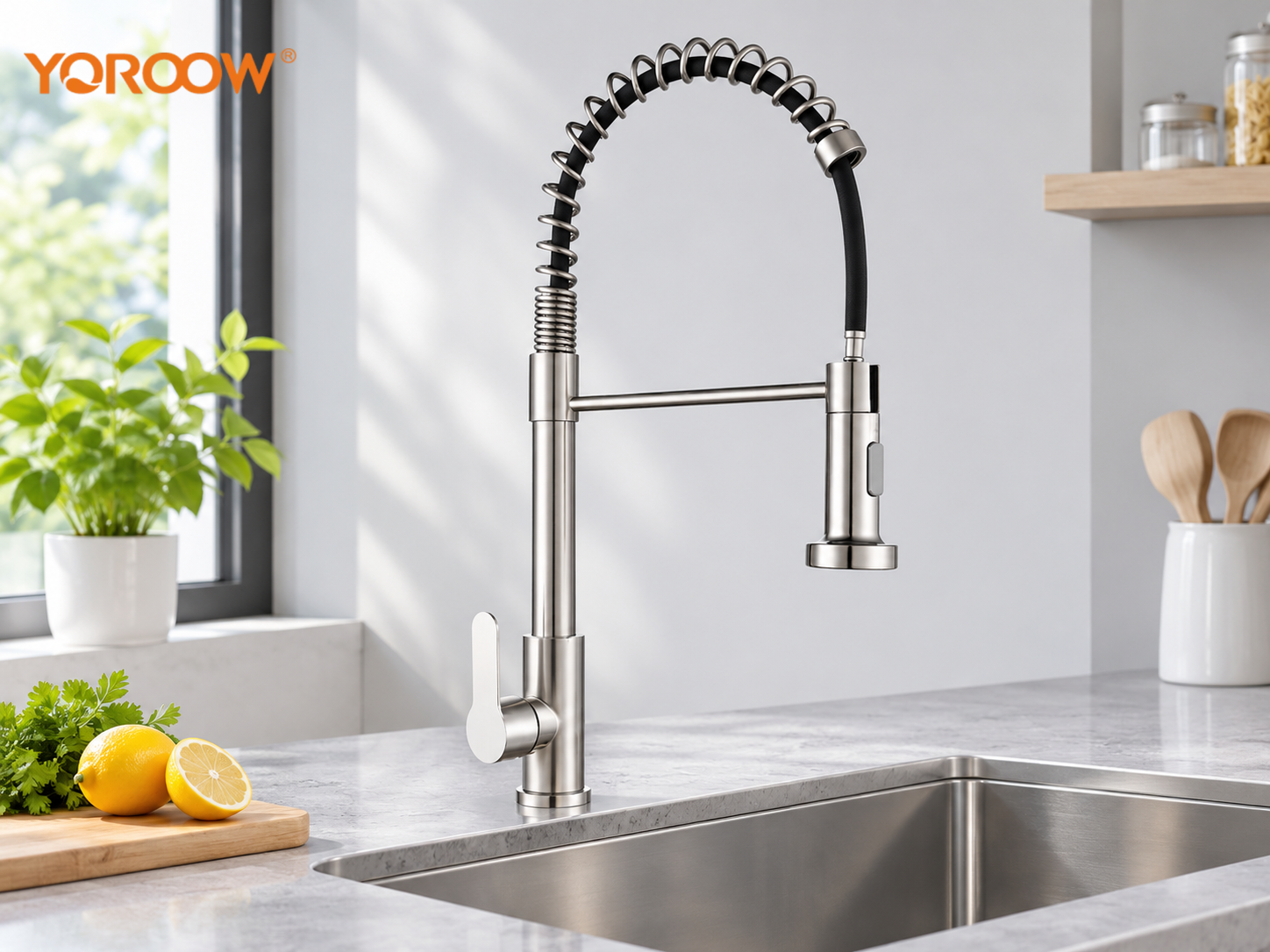
Traditional kitchen faucets mainly use swivel spouts to adjust the water outlet position. However, pull-out faucets, spring-style faucets, and multi-spray designs offer greater flexibility for different kitchen tasks.
Some semi-professional torneiras de cozinha bring flexible spout designs from professional kitchens into residential spaces. As a result, users can clean areas beyond the space directly beneath a fixed spout.
These designs are particularly suitable for large sinks, oversized cookware, and tasks that require frequent changes in washing position.
However, flexible spout designs are not limited to high-end kitchen faucets.
For example, YOROOW’s spring-style cold-water kitchen faucet combines a spring support structure with a flexible hose. This allows users to adjust the outlet position for different cleaning tasks.
From semi-professional kitchen faucets to basic cold-water models, flexible spout designs can serve different functional requirements and price segments. This reflects the diversity of structural innovation in the kitchen faucet industry.
Multifunctional Kitchen Faucets Expand Product Applications
Beyond improving the cleaning experience, some manufacturers are expanding the water supply functions of kitchen faucets. They integrate regular hot and cold water, filtered water, chilled water, or sparkling water into a single dispensing unit.
In the past, kitchen cleaning and drinking water needs often required separate devices. Multifunctional kitchen faucets bring these functions together at one location.
As a result, they can reduce the number of separate water outlets on the countertop and change how kitchen water supply equipment is arranged.
This development also expands the scope of kitchen faucet design. Manufacturers are moving beyond traditional mechanical water supply systems to explore separate water channels, function-switching mechanisms, and integration with water treatment equipment.
2. Why Are Water and Energy Efficiency Becoming Priorities in Kitchen Faucet Development?
Different kitchen tasks have different water flow requirements. Washing vegetables, rinsing dishes, and filling containers vary in flow rate, spray coverage, and duration of use.
Therefore, water-saving kitchen faucet design involves more than reducing flow rates. It also needs to consider the efficiency of everyday tasks.
Aerators, flow restrictors, and multiple spray modes offer different technical approaches to balancing water consumption with practical cleaning needs.
Energy efficiency, on the other hand, is more closely related to how hot water is used.
For example, Cold Start technology delivers cold water when users open the faucet with the handle in its central position. Users then adjust the handle when they need hot water.
This can help prevent unnecessary hot water activation during short periods of use and reduce associated energy consumption.
Rather than simply restricting water consumption, integrating water-saving and energy-efficient technologies into product design and everyday operating habits is an important direction for kitchen faucet development.
3. How Are Kitchen Faucets Becoming Part of Integrated Sink Workstations?
The development of integrated kitchen workstations offers a different design approach from improving individual faucet functions.
Some manufacturers combine sinks, faucets, cutting boards, draining racks, auxiliary sinks, and related accessories. This arrangement allows users to prepare food, wash ingredients, and drain items within the same area.
In traditional kitchen layouts, the sink mainly serves washing and drainage functions. However, in an integrated workstation, it also supports food preparation and other kitchen tasks.
As a result, the kitchen faucet needs to accommodate a wider range of working positions.
For example, when a cutting board or draining rack occupies part of the sink, a flexible spout can direct water toward different working areas.
The faucet’s swivel range, outlet position, and handle clearance also need to match the layout of the sink and its accessories.
This change broadens the scope of kitchen faucet development. Manufacturers can explore targeted product designs based on different sink dimensions, accessory combinations, and kitchen activities.
As integrated kitchen workstations continue to develop, the relationship between faucets and sinks may extend beyond traditional installation compatibility. Functional coordination and combined product design could become increasingly important.
4. How Are Smart Controls and Kitchen Faucet Designs Evolving?
Control Methods Are Becoming More Diverse
Sensor activation, touch controls, and measured water dispensing offer alternatives to traditional mechanical handles.
For example, sensor controls can reduce hand contact with the faucet handle during food preparation. Meanwhile, measured dispensing can make kitchen tasks that require a specific amount of water more convenient.
These technologies are closely related to everyday kitchen habits.
However, electronic controls also introduce additional requirements for power supply, component installation, and maintenance.
Therefore, smart faucet development needs to consider both the operating experience and practical usage conditions.
Faucet Design Places Greater Emphasis on Kitchen Coordination
Appearance options for kitchen faucets continue to expand.
In addition to traditional polished chrome, matte black, brushed metallic colors, and various PVD metallic finishes offer more choices for different kitchen styles.
This is particularly relevant in open-plan kitchens, where the faucet serves not only as a water supply device but also as a visible design element.
A wider range of colors, shapes, and surface textures allows manufacturers to develop product collections for different kitchen styles.
It also helps improve visual coordination between faucets, sinks, countertops, and other kitchen hardware.
5. What Do These Changes Mean for the Kitchen Faucet Industry?
Product Innovation and Market Segmentation Will Develop in Parallel
Technological progress in the kitchen faucet industry does not mean that every product needs to become smart or multifunctional.
Purchasing power, kitchen configurations, water supply conditions, and usage habits vary across markets.
Basic cold-water kitchen faucets, traditional hot and cold mixer faucets, pull-out faucets, and products with integrated drinking water functions all have their own applications.
For manufacturers, product innovation can involve developing new functions or improving existing structures.
For example, adding a flexible spout to a basic faucet or optimizing flow control in a traditional mixer can create development opportunities beyond high-end multifunctional products.
Therefore, the kitchen faucet industry is evolving through both technological advancement and increasingly segmented product ranges.
Determining the right functional features, product structures, and price positioning for actual market needs will influence how manufacturers develop their product collections.
Manufacturing Capabilities Need to Adapt to More Diverse Product Structures
The expansion of torneira de cozinha functions is also changing the technical requirements of manufacturing.
Traditional kitchen faucet production mainly involves body machining, cartridge assembly, surface finishing, and leak testing.
However, as product structures become more complex, manufacturers also need to adapt their production and quality verification processes.
Pull-out kitchen faucets require attention to hose movement, retraction, and sealing at connection points. Multifunctional water supply products need proper separation and connection of different water channels.
Meanwhile, smart faucets require coordination between electronic components and mechanical structures.
Developing these products involves more than creating new designs. It also requires coordination between component development, assembly techniques, and testing methods.
For the kitchen faucet manufacturing industry, an important part of turning technological innovation into practical products is applying suitable technologies to the right product ranges.
This process also needs to balance manufacturing costs, product quality, and actual usage requirements.
Conclusão
The kitchen faucet industry is developing along several parallel paths. These include structural improvements to basic products, multifunctional water supply systems, greater water and energy efficiency, and product designs that coordinate with the overall kitchen space.
Future industry competition may depend on more than the number of functions a product offers.
It may also depend on how well manufacturers understand different markets and kitchen usage scenarios, and how effectively they turn suitable technologies into products with practical value.
Main Reference:
IM Cocinas y Baños (November 20, 2026): La grifería amplía su papel en la cocina