



When a conventional mechanical faucet develops a problem, the fault is often concentrated in a relatively small number of components.
A Touchless Basin Faucet adds sensor, control and power-related components.
This makes one question especially important for long-term maintenance:
When one module fails, can that module be replaced without replacing the entire faucet?
A Touchless Faucet Should Not Turn Every Fault Into Full Product Replacement
For a touchless automatic sensor sink basin faucet, different problems may come from different areas.
A fault in the sensor, control unit, power component or water-control section does not mean that the faucet body has also failed.
A more practical repair logic is:
identify the faulty module → determine whether it can be replaced separately → consider full faucet replacement only when independent repair is not practical.
This prevents one local failure from causing the disposal of a still-functional faucet body and other working components.
Different modules also do not necessarily have the same service life.
An electronic module can fail while the mechanical body remains in normal condition.
A water-control component may need maintenance without the sensor module needing replacement.
A Touchless Faucet has real long-term repair value only when these modules can be handled independently.
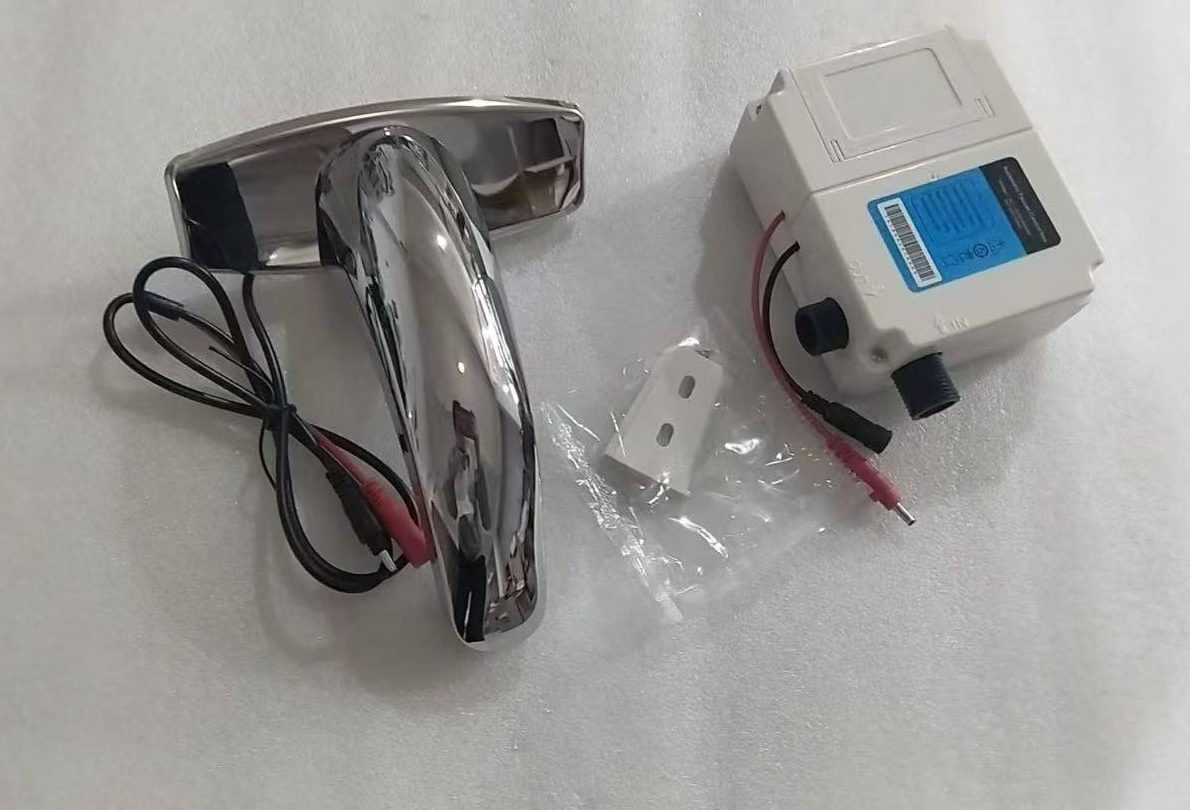
Replaceable Is Not Enough — The Component Also Needs to Be Accessible
A component may be technically removable without being practical to service on site.
If replacing one part requires removing the entire faucet body, basin or surrounding installation structure, the repair value of that Spare Part becomes much lower.
For a wash basin tap sensor product, the structure should therefore also consider Service Access:
- Can the repair technician identify the faulty component?
- Can the connection point be reached?
- Can the module be removed without disturbing the main faucet installation?
This is what makes Touchless Faucet maintenance different from simply “keeping a few spare parts.”
Real repairability depends on two things together:
a replaceable module + reasonable access to that module on site.
Spare Parts Need to Be Planned Together With the Modular Structure
After-sales support for a Touchless Faucet should involve more than a spare-parts list.
A more useful relationship is:
Fault Type → Replaceable Module → Spare Part → Replacement Method
Sensor failure, power problems and water-control issues should be linked to different inspection and replacement paths.
This makes it possible to identify what actually needs to be replaced instead of sending several potentially relevant components and testing them one by one.
The repairability of a Touchless Faucet is ultimately not about whether a part can physically be removed.
It is about whether:
a local fault can be repaired by replacing a local component without replacing the entire Faucet.
When a Replacement Module Changes, “It Fits” Is Not Enough
Electronic spare parts introduce another issue that is not always as obvious with purely mechanical components.
A replacement module may involve materials, electronic parts, wiring, power supply or other regulated elements.
When the supplier version of a sensor module, controller, power component or another electronic Spare Part changes, confirming only that the dimensions and connectors still fit is not enough.
For products intended for the EU market, the change should also be reviewed to determine whether it affects the compliance information applicable to the original product and module.
The European Commission distinguishes clearly between RoHS and REACH.
RoHS restricts certain hazardous substances in electrical and electronic equipment, while REACH is a broader chemicals regulatory framework.
This does not mean that every service replacement automatically requires a complete new certification process.
The point is to avoid assuming that:
an electronic module with different materials or different electronic construction is automatically the same Spare Part simply because it can replace the original mechanically.
For a Touchless Faucet, Replaceability means more than having a part available in the future.
The replacement part also needs to remain aligned with the product’s structure, function and applicable requirements.