



A Spring Kitchen Faucet is easy to recognize in a product image.
Its actual size can be much harder to judge.
These faucets often use a tall arch or a visible spring structure.
A shopper may check the overall height and assume the faucet will fit because there is enough space above the countertop.
However, kitchen space restrictions can come from several directions.
Height Is Only One Part of Clearance
Overall Height matters when choosing a spring loaded kitchen faucet.
Wall cabinets, shelves, or low window frames may limit the available space above the sink.
The highest point of the faucet needs enough vertical clearance.
But height alone does not tell the whole story.
Spout Reach affects how the faucet aligns with the sink.
The handle also needs enough side or rear clearance during operation.
The spring, hose, and spray-head structure may occupy space that a standard low-arc faucet does not need.
Retail dimension information should therefore help shoppers check at least three directions.
Is there enough space above the faucet?
Does the spout reach match the sink?
Can the handle and spray head move without hitting nearby surfaces?
A spring faucet sample also needs more than a simple pull-out test.
The test should repeat a normal operating sequence: pick up the spray head, rinse, return it, and shut off the water.
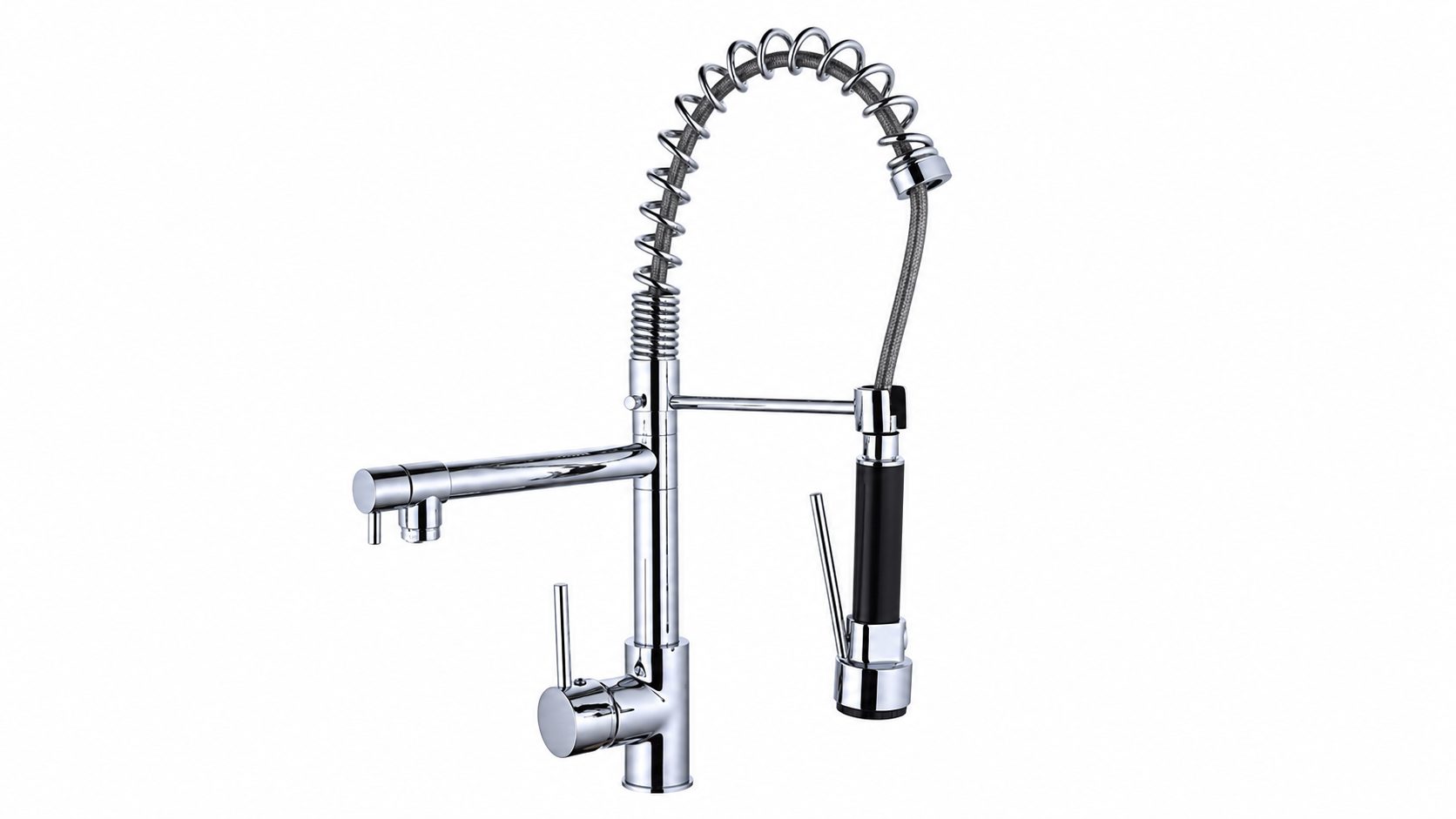
A Spring Kitchen Faucet relies on the spring, hose, and spray head to create its working range.
A product photo cannot show whether the spring may hit a cabinet behind the sink.
It also cannot confirm whether the spray head returns securely to its holder.
Retail and commercial applications may also require different test conditions.
Teams can define realistic usage frequency for each channel and record results during trial use.
If a model also targets professional kitchens, the destination market and actual application should determine the relevant standards and certification checks.
The phrase “professional kitchen” alone cannot establish compliance.
The Sink Is Also Part of the Size Check
A spring loaded kitchen sink mixer tap does not sit on an empty countertop.
The sink itself affects how well the faucet works.
Sink width, depth, and mounting position all influence the final installation.
If the Spout Reach does not suit the sink proportions, the faucet may still create an awkward water landing position.
This can happen even when the mounting hole fits perfectly.
The opposite can also be true.
A relatively tall faucet does not automatically create an installation problem if the kitchen provides enough clearance above it.
Longer spring and hose configurations need another check as well.
More hose travel can create conflicts below the countertop.
The counterweight may hit pipework, cabinet walls, or stored items.
Factories can test the return movement inside a cabinet that reflects the real installation space.
This provides more useful information than pulling the hose once on an open display stand.
Retail packaging can therefore go beyond a single line such as “Overall Height: XX mm.”
A useful dimension drawing can show Overall Height, Spout Reach, and the surrounding areas that shoppers should check.
Customers can then compare these dimensions with their actual kitchen before opening and installing the product.
For a Spring Kitchen Faucet, useful dimension information is not about showing as many numbers as possible.
Its real value comes from identifying space conflicts before installation, when the customer can still change the product choice easily.