



Keywords: Nan’an faucet factory | YOROOW | JOMOO
Nan’an, Fujian—known as the “Hometown of Plumbing in China”—embodies the core competitiveness of China’s faucet industry. Both YOROOW and JOMOO, though positioned differently, are rooted in this industrial hub. Leveraging the collaborative advantages of the industrial park, they represent a microcosm of how China’s faucet industry has risen to global leadership—driven by the success of its industrial cluster model.
I. Global Faucet Manufacturing Landscape: China Reshaping Competition
For decades, the global faucet market was dominated by traditional European and American brands. Over the past 20 years, however, Chinese manufacturing has rapidly risen, breaking industry barriers and becoming a central hub for global sourcing.
At the core of this rise is a mature, refined, and highly responsive manufacturing system. In 2023, Nan’an was recognized as a national-level specialized industrial cluster for SMEs, forming a fully integrated chain of R&D, production, and logistics. With advanced gravity casting technology and optimized brass formulations, the region combines innovation with cost advantages. Today, it hosts the largest plumbing and sanitary ware trading market in China, capable of handling diverse orders while providing end-to-end solutions.
II. Core Advantage of Chinese Manufacturing: The Collaborative Ecosystem of Nan’an Industrial Park
The global competitiveness of China’s faucet industry lies in the collaborative ecosystem of Nan’an’s industrial park, enabling optimization in cost, efficiency, and delivery.
Nan’an has built a complete industrial chain—from upstream casting and electroplating, to midstream hardware manufacturing, and downstream trade and distribution. With over 700 plumbing and sanitary enterprises forming a cluster, this ecosystem provides strong support for inter-company collaboration.
- Cost Advantage:
The industrial park forms a closed-loop supply chain, where all components can be sourced within a radius of a few dozen kilometers. Economies of scale significantly reduce procurement and logistics costs, while specialized division of labor eliminates the need for heavy asset investment. - Efficiency Advantage:
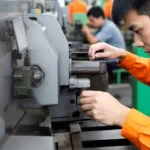
The “upstairs-downstairs supply chain” model enables rapid coordination among engineers, mold makers, and component suppliers. With 13 years of OEM/ODM experience, YOROOW leverages this ecosystem to quickly respond to market trends and deliver customized solutions, helping brands shorten time-to-market. - Delivery Advantage:
A well-established supply chain ensures strong resilience. Most enterprises are ISO 9001:2015 certified, and products comply with international standards such as CE and EN 200. Supported by port logistics, delivery stability is further enhanced.
III. Case Analysis: YOROOW and JOMOO—Differentiation Within Collaboration
Nan’an is home to over 700 plumbing enterprises, including 64 above designated size, forming a structure led by industry leaders and supported by specialized SMEs.
(1) YOROOW: A Professional OEM/ODM Manufacturing Partner
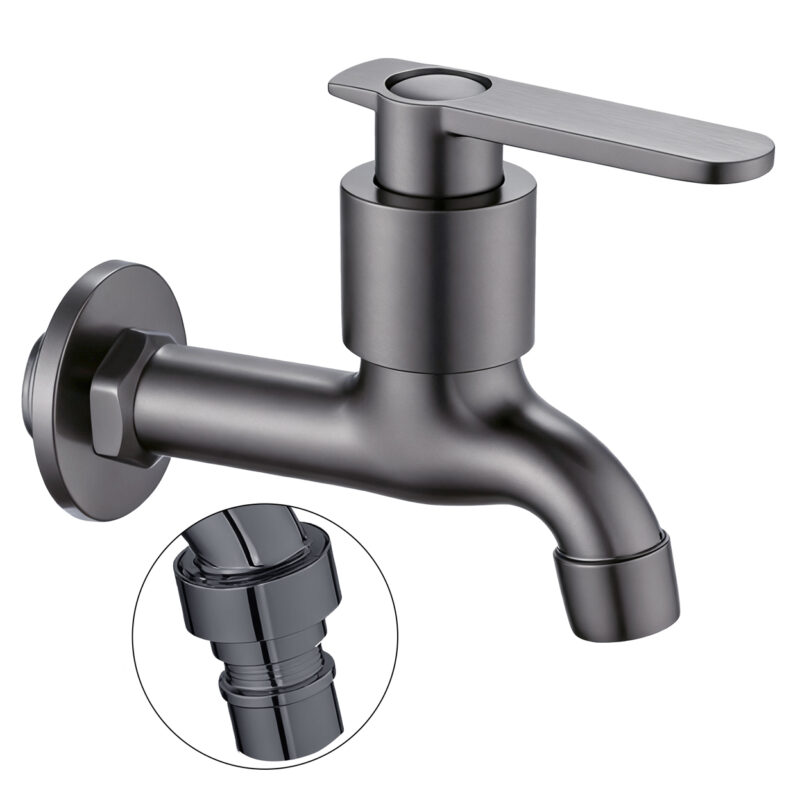
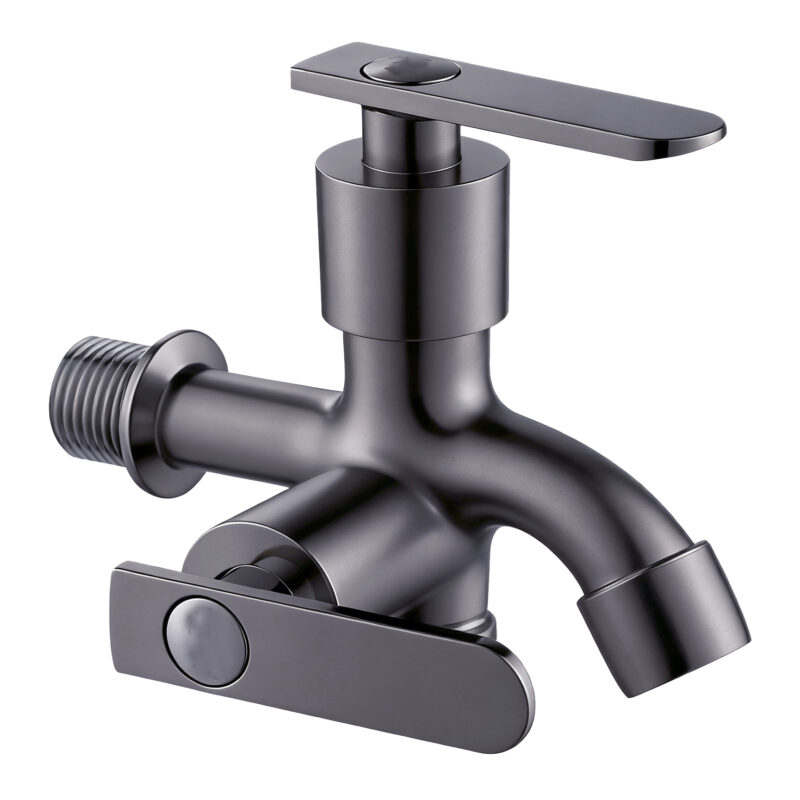
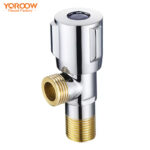
YOROOW positions itself as a global manufacturing partner for sanitary brands, with 13 years of focus on faucet production. Its core strengths lie in cost-effectiveness and flexible customization.
By leveraging the industrial park ecosystem, YOROOW has established a dual quality control system. The factory is ISO 9001:2015 certified, and its faucets meet international certifications such as CE and FCC. It provides full-process solutions—from design to mass production.
YOROOW represents the essence of China’s manufacturing model: specialization and precision, delivering stable quality, high efficiency, and strong cost performance for global buyers.
(2) JOMOO: Brand and Technology-Driven Leader
As a leading sanitary ware brand in China and a global pioneer in smart bathroom solutions, JOMOO has built a fully integrated industrial chain based on Nan’an’s foundation.
It operates 15 high-end “lighthouse factories” and 16 global R&D centers. Its 5G-enabled smart factories achieve automation and reduced labor dependency while maintaining high efficiency and energy savings. Products are exported to over 120 countries and regions.
JOMOO has led the development of more than 20 international standards and over 200 national standards, holds nearly 7,000 patents, and has ranked No.1 in the industry for 15 consecutive years. As a “chain leader,” it sets benchmarks, upgrades the supply chain, and provides high-quality support and technical reference for companies like YOROOW.
Together, YOROOW and JOMOO share core industrial resources, forming a healthy ecosystem of “leading enterprises + specialized supporting firms.” This balance between scale and diversity is central to China’s manufacturing success.
IV. In-Depth Analysis: Three Core Industrial Logics Behind China’s Manufacturing Strength
From the Nan’an industrial park, it is clear that China’s faucet factories have evolved into a system-level industrial capability. Three key logics underpin this global competitiveness:
(1) Cluster Synergy Logic: From Isolation to “1+1 > 2”
The essence of China’s advantage lies in industrial clustering—where enterprises, suppliers, and R&D institutions coexist and share resources. In Nan’an, large-scale enterprises contribute about one-tenth of the national industry output, enabling cost reduction and efficiency maximization through shared ecosystems.
(2) Flexible Service Logic: Full-Spectrum Global Adaptability
China’s flexibility is reflected in its ability to offer OEM, ODM, and OBM services, meeting diverse global demands.
YOROOW’s OEM/ODM model and JOMOO’s OBM strategy exemplify this adaptability. Supported by local policies promoting cross-border e-commerce and digital trade, Nan’an enterprises are expanding their global reach and service capabilities.
(3) Continuous Upgrading Logic: Aligning with Global Standards
Sustained upgrading is key to long-term competitiveness. From adopting international quality systems to achieving global certifications and advancing smart, green manufacturing, the industry continues to evolve.
JOMOO’s smart factories and YOROOW’s certification systems both reflect this transformation. With 931 invention patents among major enterprises, continuous innovation ensures China’s manufacturing remains globally competitive.
Conclusión
The rise of China’s faucet industry is not accidental—it is the result of a deeply integrated industrial ecosystem, exemplified by Nan’an. Through cluster synergy, flexible service models, and continuous upgrading, companies like YOROOW and JOMOO demonstrate how China has transformed from a manufacturing participant into a global industry leader.